
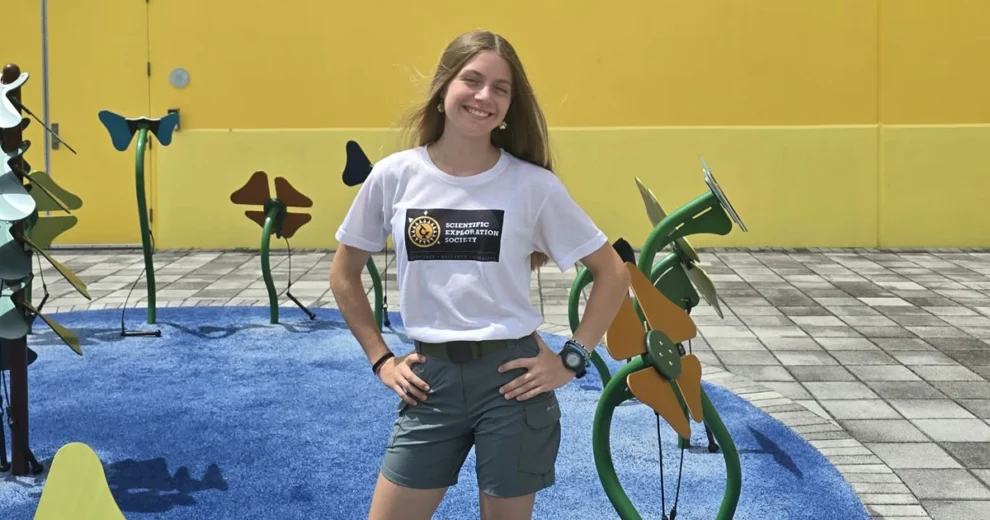
The 14-year-old Spanish tracker introduced her English-language animal book to South Florida families after a summer of international fieldwork
While many teenagers spent the summer away from school, Elvia Gómez Troya followed tiger and elephant tracks through the forests of Sumatra, supported a bird-conservation project in Benin and then traveled to Miami to share her work with young readers. The 14-year-old Spanish naturalist, tracker and science communicator visited two leading Miami institutions on August 22 and 23 to introduce the English edition of her first book, Things That Blow My Mind About Animals.
Known online as “Elvia la rastreadora,” or “Elvia the Tracker,” Gómez Troya has built an audience of more than 50,000 Instagram followers by making wildlife science understandable and engaging. Her Miami appearances connected her international conservation experience with a diverse South Florida community in which environmental education, youth leadership and biodiversity have growing regional importance.
Elvia Gómez Troya Turned Field Experience Into Science Communication
Elvia Gómez Troya’s interest in wildlife developed at an unusually early age. At 10, she spent time with members of the Hadzabe community in Tanzania. She later learned about anti-poaching initiatives in Zambia and participated in tracking and community ecotourism work with members of the Indigenous Takana people in Bolivia.
Her education was shaped in part by her father, Fernando Gómez, a professional tracker and director of SERAFO, or Servicio de Rastreo Forestal. His work has taken him to more than 40 countries to train guides, rangers and conservation professionals. Although that family influence helped introduce her to the field, the young naturalist gradually established a public voice and mission of her own.
During the summer of 2026, she spent two weeks in Sumatra collaborating with conservation organizations and local communities. Her work included tracking tigers and elephants, helping train local guides in wildlife tracking and camera-trap techniques, and participating in environmental education activities for children living near important ecosystems.
While still in Sumatra, she learned that Fundación para el Conocimiento madri+d had named her the 2026 Best Junior Science Communicator through its Spanish-language science awards. The timing connected the recognition directly with the fieldwork at the center of her public-education efforts.
Her journey continued in Benin, where she participated in bird conservation through scientific banding and helped introduce young people to tracking and wildlife-observation techniques.
These experiences reinforced a central idea in her work: conservation cannot focus exclusively on animals. It must also involve the people who live alongside vulnerable species and depend on the surrounding environment. Gómez Troya has approached local residents as sources of knowledge and essential partners rather than passive observers.
That community-centered philosophy has relevance in South Florida, where environmental protection depends on public understanding and the participation of residents from many cultural backgrounds. Her approach also echoed themes explored in the profile of Ron Magill’s lifetime of wildlife conservation at Zoo Miami, particularly the importance of inspiring young people through accessible storytelling and firsthand encounters with nature.
Elvia Gómez Troya has received several international distinctions for combining exploration, conservation and communication. She was a finalist in the 2024 EDE Awards, earned an honorable mention in the 2025 International Young Eco-Hero Awards and received the Scientific Exploration Society’s 2025 Young Scientific Explorer Award. She was the first person from Spain to receive the latter recognition. She also earned a sustainability award from Influencer Awards Spain.
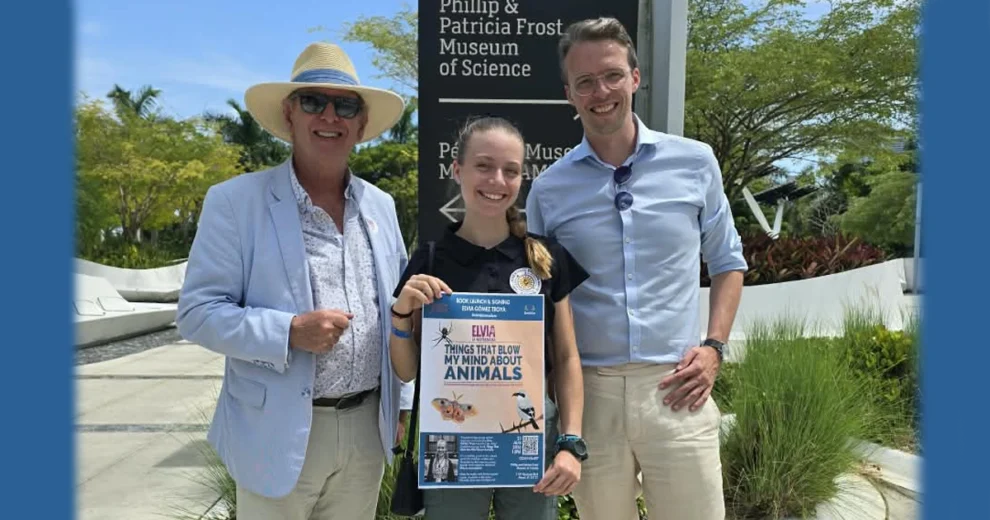
Miami Book Launches Connected Conservation with Young Readers
The Miami visit marked a new chapter for a book Gómez Troya originally wrote and illustrated when she was 11. Published first in Spanish as Cosas que me flipan de los animales, the book reached an international audience through the English-language edition Things That Blow My Mind About Animals, published by independent publisher BookGo.
The book combined animal stories, illustrations and lessons informed by the author’s experiences in nature. Written primarily for children, families and educators, it included a foreword by wildlife presenter and science communicator Nigel Marven.
Elvia Gómez Troya presented the English edition at the Miami Children’s Museum on August 22 and at the Phillip and Patricia Frost Museum of Science’s Ocean Gallery on August 23. Both appearances gave families the opportunity to meet the young author and obtain signed copies of the book.
The selection of those institutions placed her message in educational environments where curiosity and hands-on learning are central to the visitor experience. Her presentations also expanded the role of the book beyond reading: it became a starting point for conversations about animal behavior, tracking, scientific observation and the responsibility communities share in protecting biodiversity.
For Miami-Dade families, the story offered an example of how a young person’s curiosity could develop into disciplined study, international field experience and public service. It also demonstrated that science communication does not have to remain inside a classroom or laboratory. Books, museums, social platforms and community events can all help young audiences understand complicated environmental issues.
That connection between education and experience is particularly meaningful in a region surrounded by sensitive ecosystems. Families seeking additional opportunities to experience nature locally can explore wildlife and outdoor activities in Miami-Dade County parks, while the Miami education section offers continuing coverage of programs and people expanding learning opportunities across the county.
Elvia Gómez Troya has cited renowned conservation communicators Jane Goodall and David Attenborough among the figures who influenced her. Her own work, however, reflected how a younger generation is adapting science communication to contemporary platforms. Rather than relying on social media solely for visibility, she has used it to explain wildlife behavior, share field observations and encourage respect for the natural world.
Her second book, the Spanish-language work of fiction Eco Salvaje, continued that effort by introducing environmental concerns through storytelling. Together, her publications, expeditions and digital communication have advanced a consistent message: people are more likely to protect nature when they first develop knowledge, curiosity and an emotional connection to it.
The Miami presentations showed how that message could travel across languages, countries and generations. As Gómez Troya continued developing her work as a tracker and science communicator, her journey offered young people a practical reminder that age does not have to limit meaningful participation in conservation. Subscribe to Calle Ocho News for weekly Miami-Dade updates, and contact Pressnet Corp. for advertising, sponsorship, and partnership opportunities.