


At MOAD, artist William Osorio is turning the overlooked moments of domesticity into powerful figurative paintings, using materials like recycled clothing and old rugs to infuse his work with memory and a palpable sense of human history
William Osorio didn't just decide to be an artist one day. It started early, in childhood, as something fun. However, as time passed, this leisurely activity turned into a serious kind of discipline. It became a new way to connect with the world. He realized that art was crucial for true observation, revealing how everyday life, such as the routines, the fleeting moments, and the simple gestures, all carried a powerful emotional and symbolic weight.
Before he could even articulate it in words, he felt the meaning in the tensions and moments around him, meaning that just begged to be translated. Painting became, for him, a simple, direct way of seeing. Now, as the Artist-in-Residence at the Museum of Art and Design (MOAD) at Miami Dade College, he is taking that instinct and shaping it into a whole new body of work.
It’s called "La Prosa del Mundo" (The Prose of the World). The project is a deep dive into parenthood, exploring how those quiet, seemingly mundane moments of daily life can suddenly become charged with an understated, yet undeniable, poetic value.
The canvas that remembers
William Osorio has never been interested in sticking strictly to oil and canvas. His figurative style consciously pulls in materials you wouldn't typically associate with fine art. Think recycled garments, pieces of rattan, dried flowers, and even old rugs, anything that can serve as a pictorial surface.
Why this choice? Because he is deeply drawn to the memory carried by these things. They are saturated with emotional resonance, shaped by their previous use and the life they lived before finding their way into his studio.
His work explores themes that are particularly relevant to a global city like Miami: identity and otherness, the experience of immigration and belonging, and the constant tension between our interior lives and the exterior spaces we inhabit. He notes that literature and art history are constant sources, always informing and expanding his creative approach.
A family portrait, painted
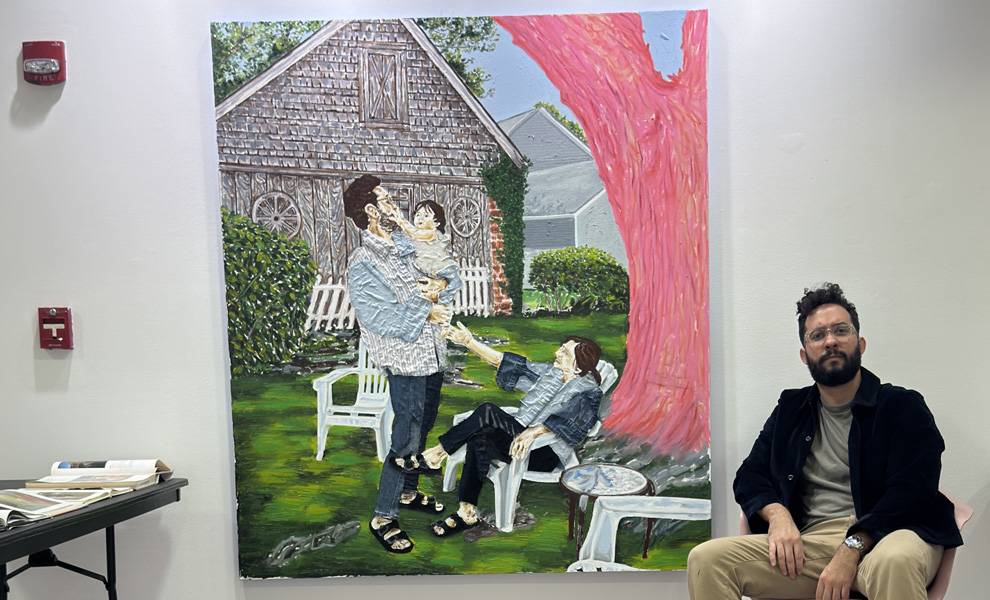
The time at MOAD, he says, has been invaluable, giving him the space to truly experiment. This freedom is evident in a piece he’s currently developing: "The Terrace at Rockport."
It’s a family portrait, drawn from candid photographs taken during a Massachusetts summer holiday. The moment he captures is exceptionally tender: the child pauses just mid-motion to touch his father’s face, while the mother holds the child's feet. It's a continuous, delicate line of touch—a "quiet language of affection exchanged between parents and child," he explains.
This tactile quality extends to the medium itself. He uses oil sticks, which create a much more direct, physical connection between his hand and the mark he makes on the canvas. Crucially, the piece incorporates fragments of those recycled fabrics, which are collaged onto the surface to help form parts of the figures.
He points out that the work is in dialogue with art history. There’s a deliberate nod to French artist Pierre Bonnard, whose own work often centered on intimate domestic scenes, specifically referencing his painting, The Terrace at Vernonnet (1939). The way the tree trunk is painted also relates to Paul Gauguin's concepts about representing forms through bold color and pattern. This piece looks at the quiet poetry found in small, everyday moments, inviting viewers to see themselves in these "quiet yet deeply charged moments."
William Osorio on cultivating curiosity
Osorio believes his work naturally connects with MOAD's mission because it's so concerned with how individuals navigate their surroundings. By looking at everyday moments through a symbolic, reflective lens, he encourages the audience to actively reconsider their relationship to their environments and the hidden histories embedded in both urban and domestic settings.
Engaging with students has been a major highlight. He hopes to contribute to a "culture of curiosity"—a place where students feel empowered to ask questions, trust their own perceptions, and experiment without fear. He plans to initiate collaborations through workshops and open conversations and aims to demystify the artistic process itself. He believes this effort will create a place for everyone to learn and reflect together.
Places like MOAD play a vital role in culturally rich cities like Miami. They give people access to exhibitions as well as to ideas and histories that help everyone grow in visual and cultural understanding. They bring together emerging and established voices and give communities a necessary platform to engage with art that challenges, informs, and broadens their entire worldview.
The slower pace of discovery
When asked about challenges, William Osorio admits that starting a completely new body of work meant facing a blank canvas with a fresh eye, requiring him to truly give himself permission to experiment. Adjusting to the different, slower rhythm of a residency—that period of openness—was initially unsettling, but also ultimately freeing. The unexpected discovery, he notes, has been how incredibly generative that slower pace turned out to be, allowing ideas to surface naturally within his new studio routine.
After the residency, the plan is to continue expanding "La Prosa del Mundo" into a larger, comprehensive series for upcoming exhibitions. His hope for visitors is simple: "I hope visitors recognize some part of their own inner life in the scenes I paint." If the work can make the familiar feel newly perceptible, he believes it has done its job—asking viewers to "pause, breathe with the image, and find meaning in its silences."
Keep up with what's happening in Miami by signing up for the Calle Ocho News newsletter. We offer advertising options to help your brand get noticed in the local community. To learn more, contact Pressnet Corp.


Add Comment