
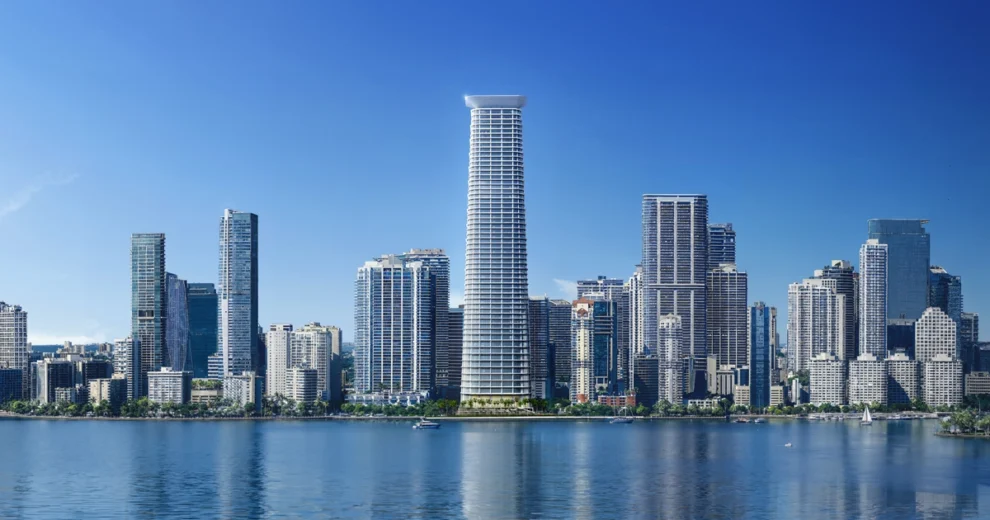
The redesigned Citadel headquarters is moving toward foundation construction with more office space and a growing physical footprint that reflects Miami’s expanding role in global finance
Ken Griffin’s decision to move Citadel’s global headquarters to Miami is becoming increasingly visible on the city’s skyline — and beneath it. Construction activity is advancing at 1201 Brickell Bay Drive, where a roughly $2.5 billion headquarters is planned for the waterfront site Citadel acquired in 2022. After years of design revisions, permitting and speculation over the project’s final form, the development is approaching foundation construction and providing a tangible measure of Griffin’s long-term commitment to South Florida.
According to an Aug. 21 report by Floridian Development, a roughly $25 million foundation permit has been filed with Miami-Dade County and remains under review. The filing follows approximately $11 million in permitted soil-improvement work that has already brought heavy equipment to the property. Crews have been performing deep soil mixing, a process that combines cement with existing soil to reinforce the ground beneath a structure — a significant early step for a tower of this size on a South Florida waterfront site.
The construction milestone comes four years after Citadel announced it would relocate its global headquarters from Chicago to Miami. Calle Ocho News examined the significance of that decision in its previous coverage of Ken Griffin’s move of Citadel to Miami and the implications for the city’s financial ambitions. At the time, the question was whether the arrival of Citadel and other financial firms could help establish Miami as a more formidable competitor to traditional financial centers. The headquarters now moving through construction offers one of the clearest physical signs of how that bet on Miami has evolved.
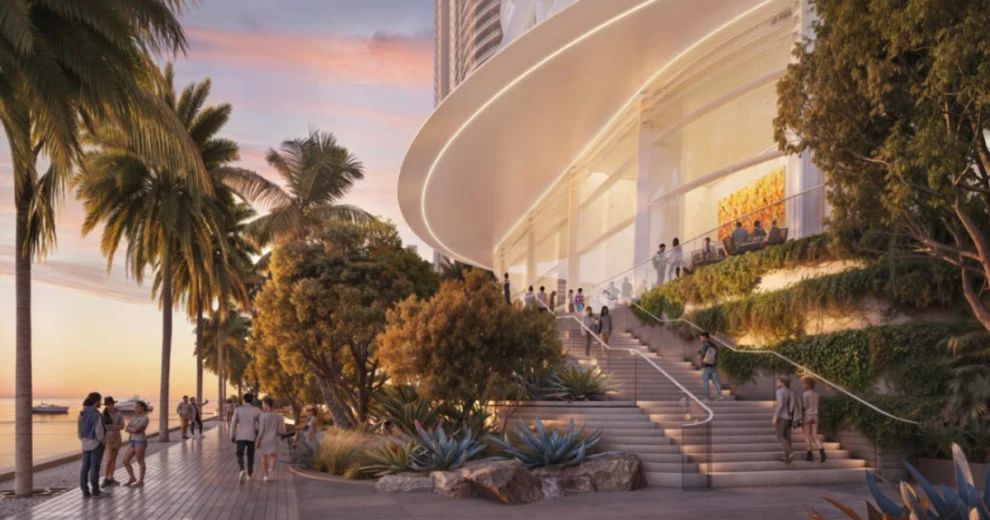
Citadel Headquarters Miami Plans Shift Toward a Larger Office Presence
The headquarters being built today differs substantially from the tower initially envisioned. Earlier versions called for a mixed-use supertall exceeding 1,000 feet and combining Citadel offices with a 212-room hotel, retail space and public waterfront amenities. Floridian Development, which has closely followed the project through Miami-Dade County filings and construction activity, reported in May that the latest plans eliminate the hotel and reduce the tower to approximately 954 feet and 52 stories.
That reduction in height could easily be interpreted as a scaling back of the project, but the underlying numbers tell a different story. Updated plans call for approximately 1.642 million square feet of office space, about 150,000 square feet more than the previous proposal. Although the overall development has been reduced from approximately 2.12 million square feet to about 1.71 million square feet, the building has become more concentrated around Citadel’s primary business operations.
The redesign therefore represents less of a retreat from Miami than a change in how the headquarters will function. By eliminating the hotel while expanding office space, the project is moving away from its earlier mixed-use concept and becoming more clearly identified as a major corporate headquarters. That distinction matters because the long-term economic significance of the development is likely to depend more on the companies, employees and business activity housed inside it than on whether the building qualifies for the architectural designation of “supertall.”
The financial commitment has also grown considerably since Griffin first acquired the site. Citadel purchased the waterfront property at 1201 Brickell Bay Drive for approximately $363 million in 2022. Floridian Development reports that the projected cost of the headquarters has since increased from approximately $1 billion to about $2.5 billion, with rising labor and construction costs contributing to the increase.
The development team reflects the scale of the undertaking. Related Companies is developing the project, Foster + Partners is leading the architectural design, Field Operations is serving as landscape architect, Kimley-Horn is handling civil engineering and Adamson Associates Architects is architect of record. No formal completion date has been announced, and a project of this complexity is expected to require years of construction.
The headquarters is also part of a longer conversation Griffin has been having about Miami’s economic potential. Calle Ocho News previously covered Ken Griffin’s discussion with Miami Mayor Francis Suarez about the city’s economy, during which Griffin discussed the business environment, education and his growing involvement in South Florida. The progression from those early conversations to a multibillion-dollar permanent headquarters illustrates how significantly Citadel’s presence in Miami has expanded.
What Citadel’s Investment Could Mean for Miami-Dade’s Economy
The importance of the Citadel headquarters extends beyond the addition of another prominent tower. Miami has spent years developing its reputation as a destination for financial services, private equity, investment firms, technology companies and entrepreneurs. Citadel’s relocation became one of the most recognizable examples of that shift because of the firm’s size and Griffin’s prominence in the financial industry.
A headquarters with more than 1.6 million square feet of office space could reinforce that trend by supporting high-skilled employment and generating additional demand for legal, accounting, real estate, hospitality and other professional services. Major employers can also influence where workers choose to live and where related companies establish offices, creating economic effects that extend beyond the boundaries of a single development.
Those benefits, however, exist alongside broader questions about how Miami-Dade manages rapid economic growth. South Florida residents are already navigating high housing costs, transportation challenges and pressure on infrastructure. As more corporations and high-income workers enter the region, policymakers and civic leaders face the challenge of ensuring that economic development contributes to wider opportunity rather than intensifying existing affordability pressures.
The Citadel project includes several public-facing components that will influence how the development interacts with the surrounding area. According to Floridian Development’s report on the latest plans, the property will include approximately 40,000 square feet of open space and nearly 70,000 square feet of retail space. The waterfront plans also include a baywalk with expanded sidewalks, landscaping and public art, creating a pedestrian connection along an area otherwise dominated by private development.
The project also includes infrastructure commitments. During an earlier stage of the approval process, Floridian Development reported that Citadel committed to a $3 million contribution for maintenance, repairs and improvements at the Financial District Metromover Station. Plans also included more than $10 million in stormwater and pedestrian improvements in the surrounding area. These investments are particularly relevant as Miami-Dade considers how transit, pedestrian infrastructure and resiliency must evolve alongside increasingly dense development.
For residents, the ultimate value of the Citadel headquarters will therefore be measured by more than its height or architectural prominence. The more consequential questions involve employment, infrastructure, economic diversification and whether Miami can accommodate its growing financial sector while preserving accessibility for the people who already live and work here.
The evolution of the project also demonstrates how quickly Miami’s development landscape can change. What began as plans for a roughly $1 billion mixed-use supertall has become an approximately $2.5 billion headquarters that is shorter but contains considerably more office space. Construction activity that once existed primarily in renderings and planning documents is now occurring on the site, while foundation permitting signals the next stage of development.
Readers can continue following corporate investment, development and the changing regional economy through Calle Ocho News’ Business & Economy coverage, where we track the companies and economic forces influencing Miami-Dade County.
Citadel’s headquarters alone will not determine whether Miami becomes one of the world’s leading financial centers, but the scale of Griffin’s investment makes it an important test of the city’s economic trajectory. Four years after the relocation announcement, the story has moved beyond the question of whether Citadel is serious about Miami. With site work underway, foundation construction approaching and more than 1.6 million square feet of offices planned, the more important question is how that commitment will shape the region around it.
Subscribe to Calle Ocho News for weekly Miami-Dade updates on business, development and the issues shaping South Florida’s future. Businesses and organizations interested in reaching Calle Ocho News audiences can contact Pressnet Corp. for advertising, sponsorship and partnership opportunities.