
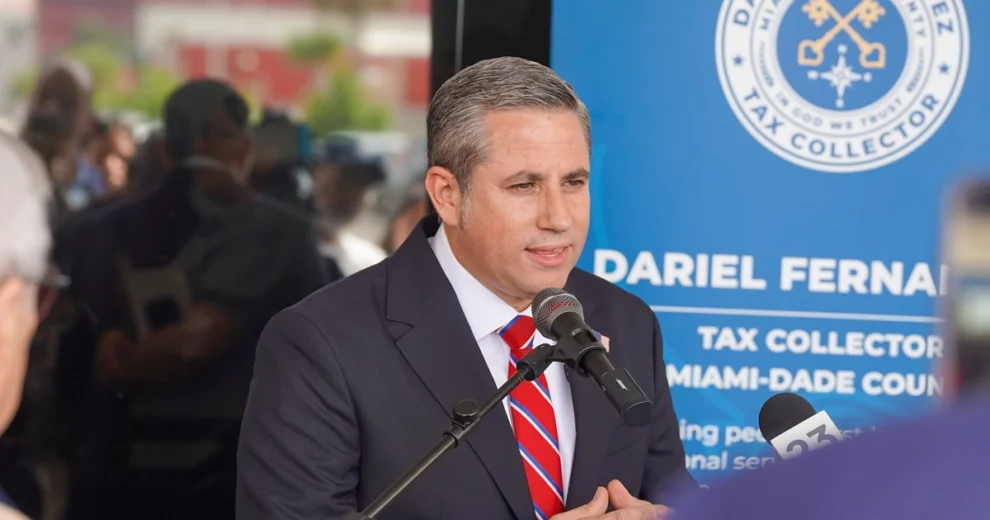
The Miami-Dade County Tax Collector says businesses engaged in unauthorized commerce with Cuba will face consequences as federal, state, and local authorities continue reviewing compliance requirements
Questions surrounding international trade compliance, federal regulations, and business accountability are once again drawing attention in Miami-Dade County following action by Miami-Dade County Tax Collector Dariel Fernandez. Fernandez announced that his office has revoked Local Business Tax Receipts associated with businesses identified by federal authorities as participating in unauthorized commercial activity involving Cuba. The action highlights the intersection of federal trade regulations, local business licensing, and ongoing community awareness surrounding commerce connected to the Cuban communist government.
According to information provided to the Tax Collector’s Office by a federal agency, Cargo Caribe LLC, utilizing a shipping terminal operated by Harkham Shipping LLC and MV Tinto Shipping LTD, exported cement from Miami to Cuba without proper authorization and in violation of federal laws and regulations. Federal authorities indicated the vessel traveled from the Miami River to the Port of Mariel, Cuba, where the cargo was unloaded. Following a review of the information and related records, the Tax Collector’s Office revoked the Local Business Tax Receipts associated with the businesses identified in the federal findings.
The action represents one of the latest compliance measures undertaken by Dariel Fernandez as part of a broader effort focused on accountability, transparency, and enforcement of laws governing business activity in Miami-Dade County.
Federal Cuba Trade Regulations Carry Local Consequences
While international trade enforcement is typically handled at the federal level, local governments also have responsibilities when businesses operating within their jurisdictions are found to be in violation of applicable laws.
Under Florida law and local ordinances, the Miami-Dade County Tax Collector’s Office has the authority to revoke or refuse renewal of a Local Business Tax Receipt when a business engages in commerce with Cuba in violation of federal law. Dariel Fernandez said the recent action reflects his office’s commitment to enforcing those provisions when credible information is provided by federal authorities.
“Miami-Dade County will not be used as a base of operations for businesses that break the law, bypass federal requirements, or engage in unauthorized commerce connected to the Cuban communist dictatorship,” Fernandez stated.
The issue carries particular significance in South Florida, where many residents maintain strong personal, family, cultural, and historical ties to Cuba. As a result, policies related to Cuba often generate heightened public interest and scrutiny throughout Miami-Dade County.
Readers interested in government accountability and public policy developments can also explore related coverage through Calle Ocho News Politics & Government coverage, including reporting on county oversight initiatives and regulatory enforcement efforts.
Business Compliance Remains a Growing Focus in Miami-Dade County
The revocation action also reflects broader efforts by the Tax Collector’s Office to strengthen compliance reviews and maintain public confidence in local regulatory systems.
Fernandez emphasized that businesses operating lawfully have nothing to fear from enforcement actions. However, he said businesses found to be engaging in fraud, misrepresentation, or unauthorized commercial activity should expect accountability under existing laws.
“This is about the rule of law,” Dariel Fernandez stated. “It is about protecting honest businesses that follow the rules and making clear that companies connected to fraud or unlawful commercial activity will not receive a free pass in Miami-Dade County.”
According to the announcement, the Tax Collector’s Office has notified the City of Miami regarding the revocations and will continue coordinating with federal, state, and local partners as part of an ongoing compliance review.
The case also underscores the growing role local agencies can play when federal findings have implications for business licensing, permitting, and operational eligibility at the local level. Observers note that these types of reviews are likely to become increasingly important as governments continue emphasizing transparency, compliance, and accountability across multiple sectors.
For additional reporting on public accountability efforts and government modernization initiatives, readers can explore previous Calle Ocho News coverage of Miami-Dade County Tax Collector reforms and business compliance enforcement efforts at Calle Ocho News Community Coverage and related reporting on local government oversight at CalleOchoNews.com. As Miami-Dade County continues balancing economic growth with regulatory oversight, cases involving business compliance and federal trade laws remain important topics for residents, business owners, and policymakers alike. Subscribe to Calle Ocho News to get weekly Miami updates and ongoing coverage of government, business, and community issues impacting South Florida. Want to feature your business? Contact Pressnet Corp. for advertising, sponsorship, and partnership opportunities, and continue exploring related stories on CalleOchoNews.com.